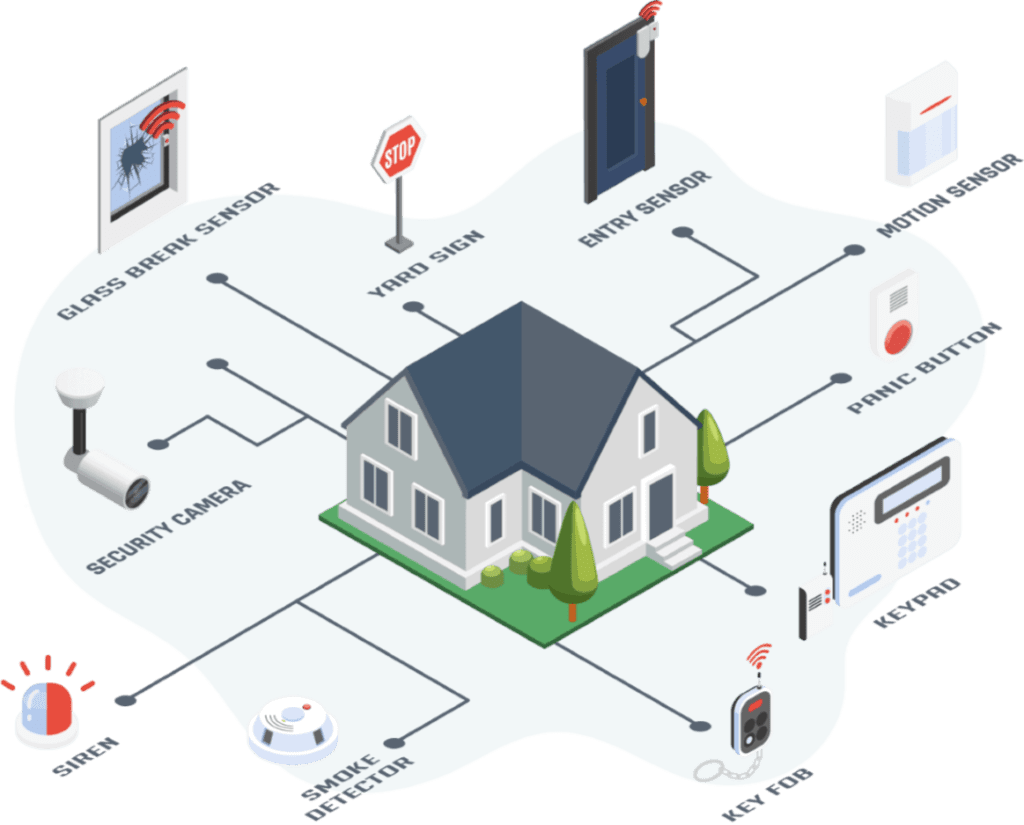
A Typical
Home Security
System Consistas of:
Entry sensor: Also known as contact sensors, entry sensors have two parts: one that goes on the window or door and another that goes on the frame. These sensors use magnets to determine when one of these entrances is opened or closed.
Glass break sensor: A glass break sensor detects the sound of glass breaking and alerts us via mobile notification.
Siren: Sirens exist in home security systems both on their own and as part of other devices, such as the base station. Sirens often go off at the same time as other alarms and are intended to scare intruders away or alert the neighbors.
Keypad: To arm or disarm security systems which commonly require a code, that we enter on a keypad mounted to the wall or placed on a flat surface.
Key fob: Key fobs allow us to disarm or arm our security system without having to use a keypad. They’re perfect for when we are upstairs and just do not feel like leaving our bed!
Panic button: If something goes wrong, a panic button is an easy and fast way to alert emergency services, be it the police, hospital, or even the fire department. Like key fobs, panic buttons are not installed anywhere in particular, but we always have one around in case of an emergency.
Base station: Base stations sync all of the connected devices with our mobile application so we can receive those notifications we mentioned earlier.
Yard sign and/ or window stickers: Many security systems also give out yard signs or window stickers that allow us to advertise that we have a security system. Often, burglars will turn around if they see a security system, so these signs are good to have.
Smoke and CO detectors: We recommend that every home have a smoke and carbon monoxide detector. With this simple tool, we are alerted if the air in our home becomes unsafe to breathe.
Order Your FREE* Security System From The #1 ADT Authorized Provider In The Nation!
With $99 installation charge and new monitoring agreement starting at $49.99 per month. Early termination applies. See full terms for details on page 4.